Going Back: What I Was Afraid Of and Why I Went Anyway
Part two of a four part series.
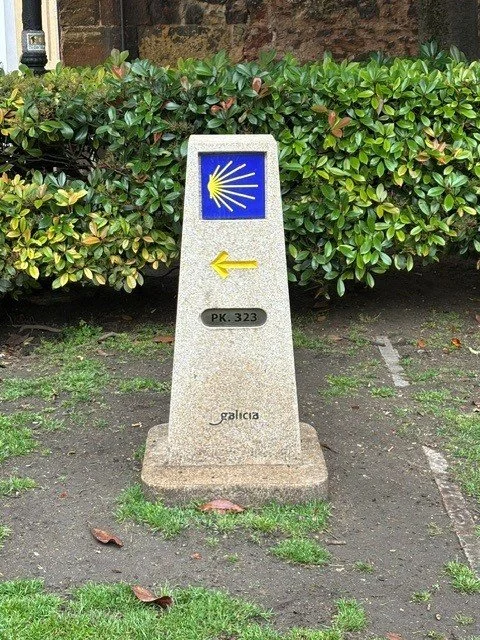
I told you in the last post that my husband and I went back to the Camino in 2026 to walk the section of the Primitivo route we had missed two years earlier.
What I didn't tell you yet is that I was nervous about it.
Not logistically nervous. Not is-my-gear-ready nervous. Genuinely, in-my-body nervous in a way I hadn't fully anticipated until we had landed in Spain and it suddenly became real.
The Thing About Telling a Story From a Distance
For two years, I had been telling the story of the first Camino to friends and then on stage. The broken arm. The adjustment. My mother's death. The way the trip both fell apart and somehow still gave me something I needed.
When you tell a story often enough, you get good at it. You learn where the beats are, where to pause, where the audience leans in. It becomes something you can hold steadily, examine from multiple angles, offer to a room full of people as something useful.
What I had not fully reckoned with was that telling a story and walking back into it are two different things.
We can intellectually understand something — truly understand it, be able to articulate it clearly and even help other people with it — and still have a full physical and emotional response when we encounter it again in real life. Knowing the theory does not make you immune to the experience.
I talk about this with clients and audiences regularly. The nervous system doesn't care how well you understand what's happening to it. When something has been associated with pain or loss, your body remembers. Walking back toward that trail was going to ask something of me that no amount of keynote preparation had fully accounted for.
What Fear Was Telling Me
As the beginning of the walk approached, I noticed fear showing up in a few different ways.
Some of it was about the trail itself. The Primitivo is steep. The terrain is uneven. I had, after all, fallen on it once already. My brain was very interested in reminding me of this.
But underneath that was something quieter and harder to name. A worry that going back would somehow crack open the grief I had worked so hard to integrate. That standing in the place where I had broken my arm and then staying in the same city where I had learned my mother had died, would undo the steadiness I had built around those experiences.
That is a real fear. And I want to name it as such, because I think a lot of us have a version of it. We avoid going back to hard places, physically, emotionally, relationally, because we are afraid that the progress we have made is more fragile than it feels.
Why I Went Anyway
I went anyway for one reason, really. I did not want fear to write the ending to this story.
I had spent two years building something meaningful out of that difficult trip. I had watched it become the foundation of work I believe in. And I knew, with a clarity that was stronger than the fear, that there was more trail left to walk and that walking it mattered to me.
I also knew something I have learned both from my own experience and from years of working with people in burnout and hard seasons: avoidance preserves fear. It doesn't resolve it.
The only way out was through. That is not a very original insight. But it is a true one.
The Moment We Passed the Spot
When we reached the section of trail where I had fallen two years earlier, something in my chest tightened. My brain started cycling through the memory. My body knew exactly where we were.
I kept walking.
And then we passed the spot.
And so much of what I had been carrying loosened.
Not all of it. I don't want to oversimplify this or make it sound tidier than it was. But there was a real and significant shift when my body understood that we had gone back, and we were okay, and we were still moving forward.
I already felt like I had accomplished something, and we still had many miles ahead of us.
What This Has to Do With You
I share this not because pilgrimage trails are a universal experience, but because the internal terrain of going back to something hard is one most of us have navigated or will navigate.
The conversation you have been avoiding. The relationship that still needs tending. The work you loved before burnout made it feel impossible. The version of yourself you put on hold during a hard season and haven't fully returned to yet.
Fear does not mean stop. It means this matters to you.
And sometimes the most important thing you can do is keep walking.
Next in the series: what the trail actually looked like when it was hard — and what kept us going.