The Trip That Didn't Go as Planned
I want to tell you about a trip that didn't go the way I had planned.
Not a little off track. Not a minor adjustment. The kind of off track where you end up in a hospital in a foreign country, your arm in a sling, looking at the trail you came all this way to walk and trying to figure out what comes next.
This is a story about the Camino de Santiago, part one of a four part series. But it's also a story about what we do when life disrupts the plan we were so sure about. And because that happens to be the topic I spend most of my professional life talking about, it felt like time to share it.
What the Camino Is
The Camino de Santiago is an ancient network of pilgrimage routes in Spain that converge at the Cathedral of Santiago de Compostela. People have been walking it for over a thousand years. These days, hundreds of thousands of people from all over the world walk it every year, each for their own reasons.
My husband and I had been drawn to it for years. In the spring of 2024, we finally went. We had planned to walk the Primitivo route, one of the oldest and most rugged of the Camino routes, winding through the mountains of northwestern Spain.
We were prepared. We had trained. We had the gear. We had the itinerary and the excitement and all the things you bring when you have been looking forward to something for a long time.
Day Two
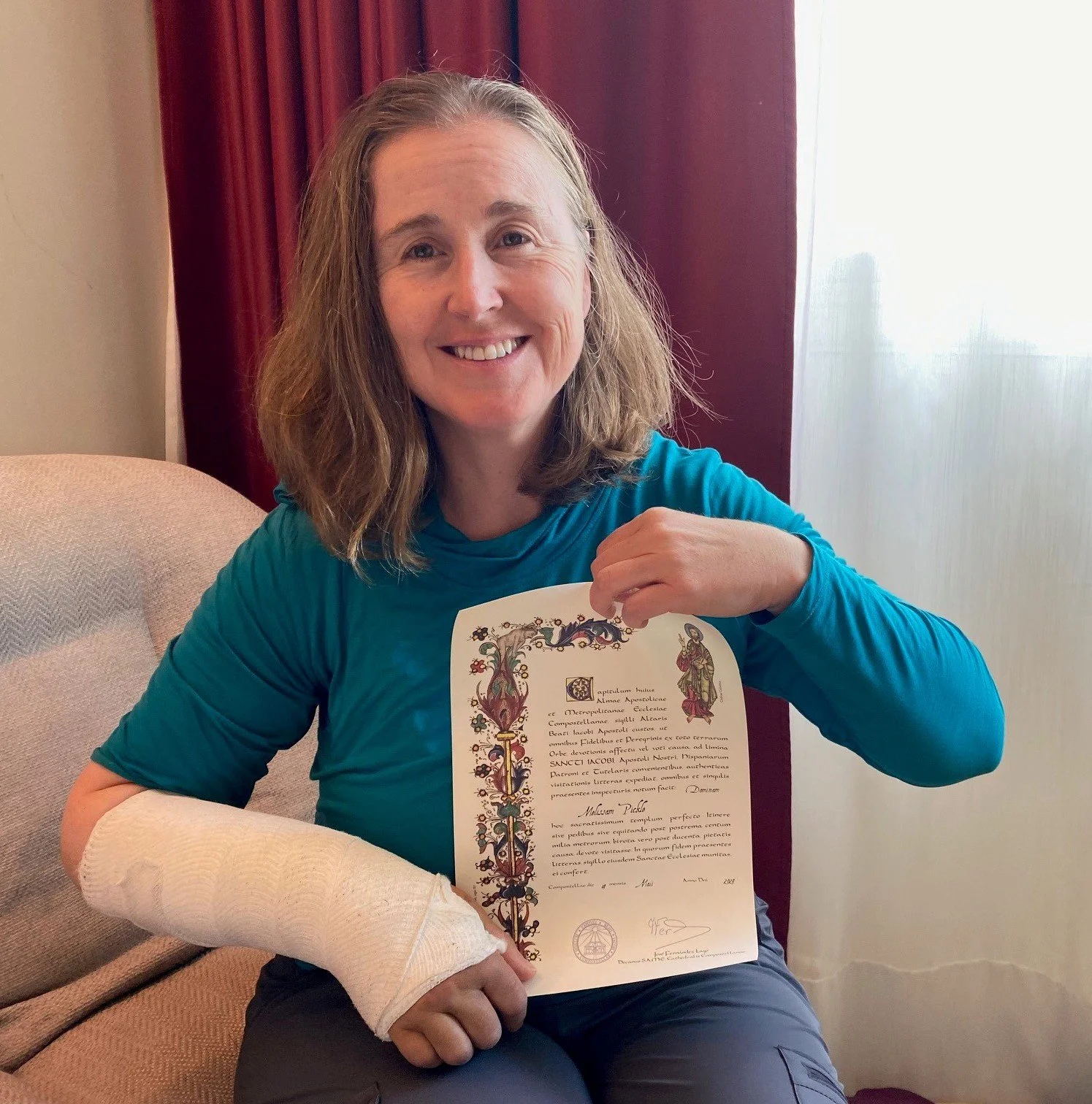
On the second day of walking, on a wet section of trail, I slipped. My wrist tangled in the strap of my walking pole on the way down, and when I hit the ground, I broke my arm.
Just like that.
We took several days to recover and figure out our next steps. The mountain section of the Primitivo, the part we had specifically trained for and traveled to walk, was no longer an option. So we made a decision that felt both practical and a little heartbreaking: we took a bus to Lugo, bypassing that section of the trail, and from there we walked the last hundred kilometers to Santiago de Compostela.
We finished. We got our certificates, the Compostela, at the end. We stood in Santiago and we had done something real.
But the section we had come for, the rugged mountain route of the Primitivo, was still unfinished.
And then, near the end of our trip, still in Spain, I got word that my mother had died.
Two significant losses woven into one journey. My arm. My mom. The route we had planned. The version of that experience I had been holding in my mind for so long.
I came home a different person than the one who had left.
Here is what I have learned, both personally and in my work with people navigating burnout and hard seasons: the disruption of a plan is not just a logistical inconvenience. It is a loss. And losses deserve to be treated as such.
What Adapting Actually Looked Like
I want to say something about those days between the hospital and getting back on the trail, because I think this part often gets skipped in the stories we tell about hard times.
We didn't immediately pivot and push forward. We stopped. We rested. We sat with the fact that the trip had changed, that my arm was broken, that the plan was no longer the plan. We gave ourselves time before we decided what came next.
That decision, to take the bus to Lugo rather than push through something my body couldn't do, was not giving up. It was adapting. There is a difference, and I think it matters.
Adapting means you stay in the game. You reassess what's possible, you adjust the plan, and you keep moving toward something that still matters. That is not the same as quitting. And it is not the same as pretending nothing happened.
We finished what we could finish. And we held the rest for another time.
What I Did With It When I Got Home
I didn't come home and immediately make meaning out of it. That is not how grief works, and anyone who tells you otherwise is trying to skip steps.
I came home and I sat with it for a while. I let it be hard. I let the trip mean something painful before I let it mean something useful.
But eventually, as it tends to do, the experience started to settle into something I could hold more steadily. The broken arm became part of my keynote. The Camino became the central metaphor for what I talk about on stage because it turns out that walking a difficult trail and navigating burnout have more in common than you might expect.
And the unfinished section of the Primitivo sat quietly in the back of my mind.
Why Going Back Mattered
I did not want the Camino to be forever colored by those two events. I did not want my only story about that trail to be one of loss and interrupted plans. Not because I wanted to deny what happened, but because I knew there was more trail left to walk, and I wanted to walk it.
In the spring of 2026, my husband and I went back to Spain. We walked the section of the Primitivo we had missed. Every mile of it.
This series of posts is about that return trip. What it looked like. What it felt like. What it taught me that I am still processing.
But I am starting here, with the first trip, because the return only makes sense if you know what we were returning from.
The Camino has a phrase that pilgrims say to each other on the trail: Buen Camino. It means, simply, good journey. Not easy journey. Not smooth journey. Just good.
I think about that a lot.
Is there something in your own life you've had to adapt around rather than abandon, something still waiting to be finished on your own terms?