What Hard Actually Looked Like
Part three of a four part series.
I want to be honest with you about something.
When people hear that I walked the Camino de Santiago, the response is often a kind of reverent admiration. It sounds romantic. Ancient trail, beautiful landscapes, spiritual journey. And it was all of those things.
It was also genuinely, physically, unrelentingly hard. And I think it's worth talking about that part, because I think we do a disservice to hard experiences when we skip over the difficult details in favor of the beautiful ones.
This post is about what the trail actually looked like when it was hard. Because I think there's something important in that, especially for the helpers and caregivers and high-achievers reading this who have a long history of minimizing their own difficulty.
The Terrain
The Camino Primitivo is not a gentle walk in the countryside. It is one of the most challenging of the Camino routes, and the section we walked delivered on that reputation every single day.
The climbs were steep. The kind of steep where your legs are burning before you have fully woken up for the morning. The descents were equally demanding in their own way, long, uneven, the kind that works muscles you don't use in everyday life until those muscles are loudly reminding you of their existence.
Some days it rained from the moment we started walking until the moment we stopped. Not a light mist. Full, soaking rain. Shoes wet through, clothes soaked, trail turned to mud under our feet.
My legs were sore. My feet had strong opinions about what we were asking of them. There were moments on the trail when I thought: this is hard. Just simply, plainly, honestly hard.
The Nights
Along the Camino, many pilgrims stay in albergues, pilgrim hostels that offer basic accommodation at low cost. The trade-off for affordability is, shall we say, ambiance.
Some nights we shared a room with sixteen other people. Sixteen people with their own sleep schedules, their own snoring, their own 5 a.m. alarms. You learn quickly that earplugs are not optional. You also learn that even with earplugs, you are not going to sleep the way you sleep at home.
We were tired a lot. The kind of tired that accumulates over days when you are asking a lot of your body and not getting quite enough rest to fully recover between asks.
This is something I know professionally, and I was living it personally: when we are in the middle of sustained effort, recovery isn't optional. It's what makes continued effort possible. Skipping it doesn't toughen you up. It just means you're running on a shrinking reserve.
What Kept Us Going
So why didn't we stop? That is not a rhetorical question. On some of the harder days, stopping would have been a reasonable choice.
A few things kept us moving.
The first was purpose. We had come back to finish something that mattered to us. That meaning didn't disappear when our legs were sore or when it was raining sideways. If anything, the difficulty made the purpose feel more real, not less.
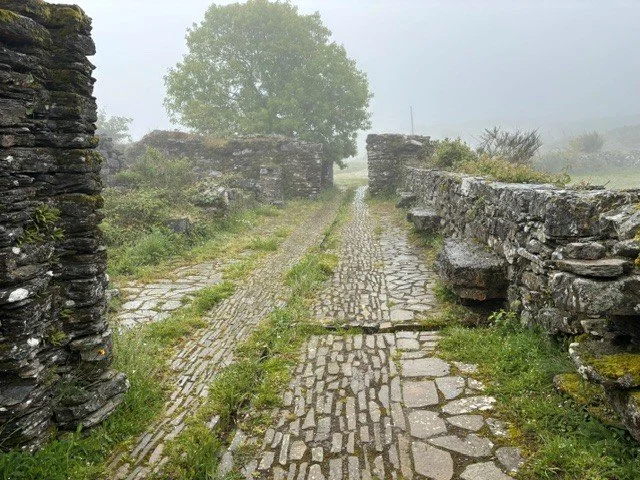
The second was the trail itself. Whatever else was true on any given day, the Primitivo route is staggeringly beautiful. Mountains, forests, ancient stone villages, views that stopped us mid-step. The trail kept giving us something worth walking toward. Beauty doesn't make hard things easy, but it does make them worth it.
The third was the company. My husband walked every mile alongside me. On the hard days, that mattered more than I can adequately describe. We didn't always talk. Sometimes we just walked. But we walked together, and that was enough.
What This Has to Do With Burnout
I work with people who are exhausted. Teachers, nurses, social workers, early childhood professionals. People who are in sustained hard effort, often without adequate recovery, often without enough beauty or purpose visible to them in the day-to-day, often feeling like they are walking alone.
The Camino gave me a physical experience of something I had been saying from the stage for years: hard and worthwhile are not opposites. You can be genuinely depleted and genuinely glad you're doing what you're doing at the same time. Those two things can coexist.
But the depletion still requires attention. You still need rest. You still need recovery. You still need something to remind you why the trail is worth walking.
Pushing through is sometimes necessary. But it is not a substitute for taking care of yourself. And the people who make it to the end are not the ones who never struggled. They're the ones who kept tending to themselves along the way.
The final post in this series: what it felt like to finish.